
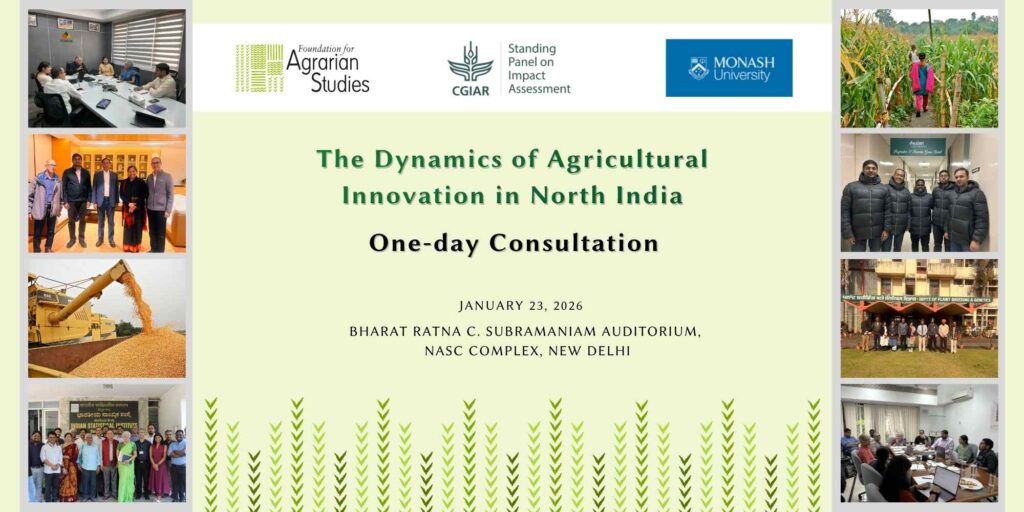
On Friday, January 23, 2026, the Foundation for Agrarian Studies (FAS), in collaboration with Monash University, Australia, and ICAR-National Bureau of Plant Genetic Resources (NBPGR), organised a one-day consultation at the National Agricultural Science Complex (NASC), New Delhi. The consultation was part of the research project, “The Dynamics of Agricultural Innovation in North India,” funded by CGIAR-Standing Panel on Impact Assessment (SPIA). The project aims to comprehensively document CGIAR-related innovations in North India since 2000, and study the reach and adoption of a select few innovations that have achieved scale.
In 2025, the major task under the project was the systematic identification and documentation of CGIAR-related innovations in North India since 2000, which culminated in the preparation of a draft longlist of innovations. The consultation aimed to solicit expert feedback on this list and to gather suggestions and inputs to address the remaining gaps in the longlist. More specifically, experts’ inputs were sought on specific sources of evidence that could establish the scale of adoption and the regional spread of different innovations. This would help in identifying a shortlist of innovations for further study.
The consultation began with an introductory session chaired by Professor V. K. Ramachandran (Vice Chairperson, Kerala State Planning Board, and Trustee, FAS), followed by welcome addresses by the two Principal Investigators of the project: Professor Madhura Swaminathan (Head, Economic Analysis Unit, Indian Statistical Institute, Bengaluru, and Trustee, FAS) and Dr. Gaurav Datt (Associate Professor, Monash University). Professor Ramesh Chand (Member, NITI Aayog) delivered the keynote address on the CGIAR’s evolving vision on agricultural development in India. Dr. James Stevenson (Senior Research Fellow, Country Studies, SPIA) introduced SPIA Country Studies, drawing evidence from Ethiopia, Uganda, Vietnam and Bangladesh, and followed by a presentation by Dr. Sandipan Baksi (Co-Principal Investigator and Director, FAS) on the Country Studies for North India, particularly the steps and methodology undertaken to compile the comprehensive list of innovations.
The main deliberations were conducted through two parallel breakout sessions chaired by members of the Project Advisory Committee. Breakout Session I, focusing on crop improvement, was chaired by Professor K. C. Bansal (Former Director, ICAR-NBPGR, and Adjunct Professor, Murdoch University, Australia) and Professor R. Ramakumar (School of Development Studies, Tata Institute of Social Sciences). Breakout Session II, which covered aquaculture, seed production techniques, digital advisory tools, scientific management of natural resource management (NRM) practices, machinery and agronomic practices, and policy contributions, was chaired by Shri. P. C. Mohanan (Chairperson, Kerala State Statistical Commission) and Dr. V. Surjit (Associate Professor and Head, Centre for Agrarian Studies, National Institute of Rural Development and Panchayati Raj, Hyderabad).
A reporting session was convened and chaired by Dr. Anil Kumar Dixit (Assistant Director General (PIM), ICAR), during which the Chairs of the two breakout sessions presented consolidated summaries of the discussions of the breakout sessions. This was followed by a plenary discussion on the way forward. The consultation concluded with formal closing remarks and a vote of thanks.
The consultation was attended by scientists and administrators from several NARES-ICAR institutes and State Agricultural Universities, as well as participants from CGIAR centres operating in India and CGIAR-SPIA. Participants offered valuable feedback, methodological insights, and suggestions on data sources relating to the scale of adoption of different innovations, which will help the project team prepare the shortlist of innovations for the subsequent stages of the project.