
From West Bengal to West Godavari: Rural to Rural Migration of Casual Wage Workers in Agriculture
This note describes the short-term, seasonal migration of landless Scheduled Caste and Scheduled Tribe workers from West Bengal to Andhra Pradesh. Using data and information collected in West Godavari district, Andhra Pradesh, in July, 2026, as part of FAS’s Project on Agrarian Relations in India (PARI), it documents the socio-economic characteristics of the migrant workers, the nature of their work, and the role of the intermediaries involved.
For large sections of wage workers in rural India, temporary, short-term migration comprises an important source of livelihood. It accounts for the bulk of the migration flow in the country, yet official statistics have captured this phenomenon inadequately (Deshingkar and Akter, 2009). Contrary to traditional theories on labour migration, it includes not only the migration from rural to urban areas, and from agricultural to industrial sectors, but also between rural areas and between agricultural regions themselves. Workers migrate from regions with fewer days of work and lower wages towards regions of high-productivity agriculture, where seasonal demand for labour is correspondingly higher, as seen in the agricultural regions of Punjab and Haryana after the Green Revolution (Gill 1984; Singh 1995).
A relatively recent instance of rural-rural migration in India is that of casual wage workers in agriculture from rural West Bengal to the States of Andhra Pradesh, Telangana, and Tamil Nadu. According to The Hindu, more than four lakh workers from West Bengal temporarily migrate to the States of Andhra Pradesh and Telangana across two crop seasons in a year (Rao 2023). This migration stream is of particular interest for two reasons. First, it represents the migration of rural labour, in substantial numbers, between two regions that are both characterised by relatively high agricultural productivity. Second, this corridor appears to be a relatively recent phenomenon, reported to be not more than two decades old and increasing in numbers in recent years.
Yendagandi, the village under study, is located in the delta of the Godavari River, a region with high-productivity cultivation of rice and fish and shrimp aquaculture, the income from which makes it one of the most prosperous rural regions in the country. Rice is cultivated across two seasons – sarwa (July to November) and dalwa (January to April). Paddy is grown by transplanting seedlings by hand from nurseries – this is a labour-intensive operation for which migrant workers are hired through labour contractors.
In July 2026, five groups of migrant workers were hired for manual paddy transplantation in Yendagandi. Each group consisted of 10 to 15 members. A team from FAS conducted semi-structured interviews with members of three of the five groups. The majority of these workers hailed from Purba Bardhaman district (1) in West Bengal, and the remaining workers came from North 24 Parganas, South 24 Parganas, Malda, Murshidabad, Purulia, and Bankura districts in West Bengal, and Dumka district in Jharkhand. All of the workers belonged to Scheduled Caste or Scheduled Tribe households that did not own any land. The groups included young and older men and women, and both first-time and repeat migrants. Some of the repeat migrants reported they have been visiting the region for over two decades now.
The Nature of Work
Paddy transplantation is performed manually by workers in groups, who are paid on a piece-rate basis. The immediate reason, as reported during the fieldwork, for relying on migrant labour over local labour is that the former is more “efficient.” This essentially means that their wages are lower, and the extent of land operated by them per day is higher. The reported cost of local labour was Rs 5,500 per acre during sarwa in 2026, against Rs 4,500 per acre for migrant labour.
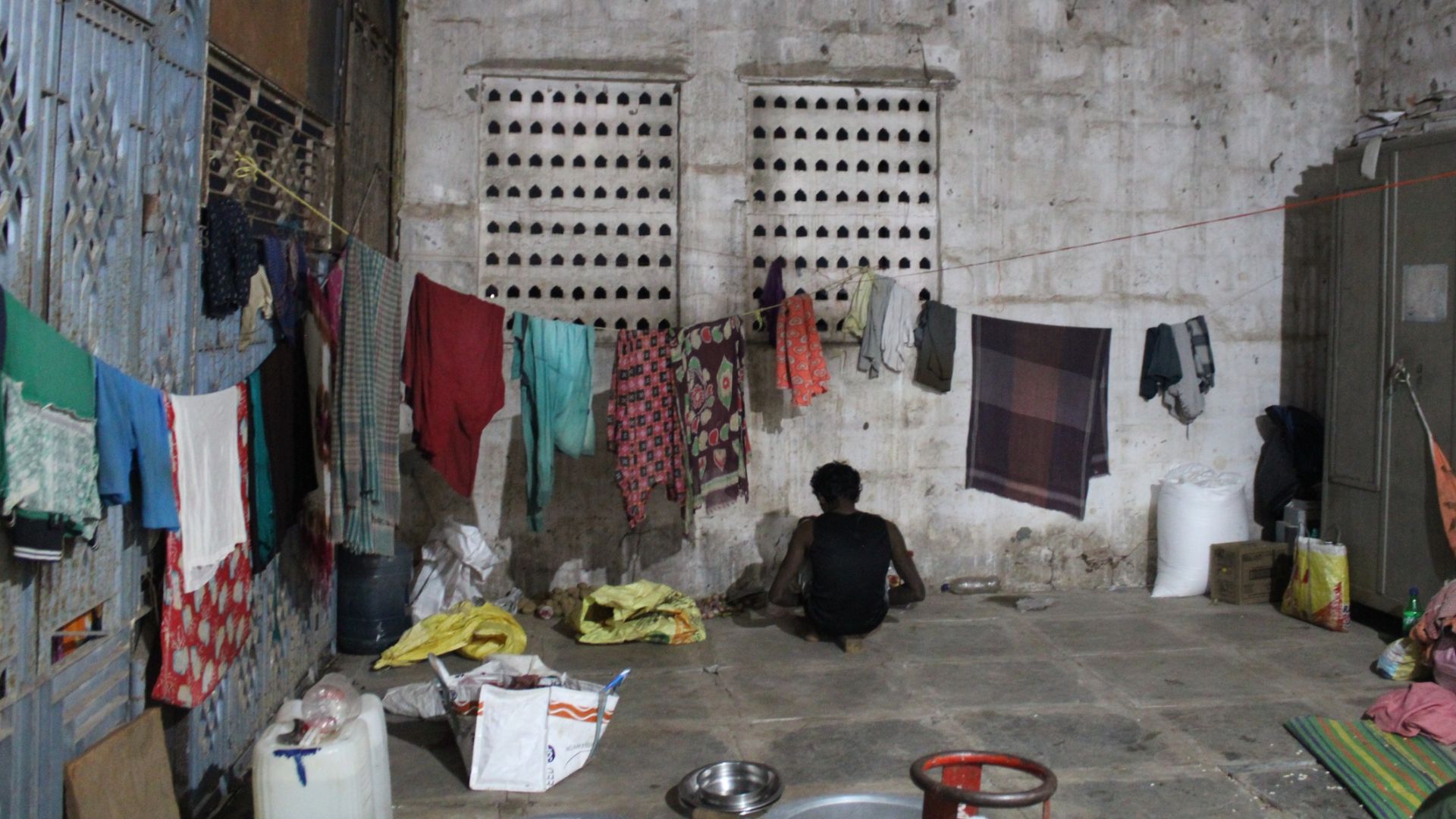
Migrant workers earn Rs 3,200 per acre – less than 60 per cent of what local workers earn. The contractor retains the difference between what the farmer pays and what the workers receive. A small part of this amount is the contractor’s expense for providing shelter (2), rations of rice, a gas cylinder for cooking, and diesel for running the generator used for electricity. We estimate that the contractors retain a margin of Rs 1,000 per acre after all expenses.
In addition to the lower cost, migrant workers are reportedly preferred for their transplanting method, locally referred to as “Bengal Udupu,” where the seedlings are planted in straight lines with wider spacing between plants, resulting in higher yields (Rao 2023).
The three groups interviewed reported working on a total of 159.25 acres of land in 19 days, at an average rate of 3.9 acres per group per day, working for 13 hours a day on an average. The first group, consisting of 12 members, including four women, covered 68.6 acres in 17 days, at an average of 4 acres per day, with each worker estimated to have earned Rs 18,293 for that period. The second group, consisting of 10 members, including five women, covered 37 acres in 11 days, at an average of 3.4 acres per day, and an earning of Rs 11,840 per worker. The third group, consisting of 15 members, including six women, covered 53.65 acres in 13 days, at an average of 4.1 acres per day, with an earning of Rs 11,445 per worker (see Appendix). The third group had reached Yendagandi after working in Eluru (an adjacent district), where they transplanted paddy on 42 acres of land in 15 days, at the rate of Rs 3,300 per acre. After concluding their work in Yendagandi, they headed back to West Bengal.
A group typically covers 80 to 100 acres across villages in a period of less than two months in a visit. From this arduous labour, a worker in a group of 10 members, working for 25 days, can earn in the range of Rs 25,000 to Rs 30,000 in a visit, excluding daily expenses, which are partly met by the contractor. This is equivalent to Rs 1,000 per day or Rs 615 per eight-hour day. These short spells of migration create income opportunities for these workers that are otherwise absent for most of the year.
“Circular” Migration
The workers migrate due to inadequate employment and low wages resulting from a failure of the local labour market. They migrate during the lean season in agriculture at the source (where paddy and potato are the principal crops cultivated), which coincides with demand for migrant labour for paddy transplantation at the destination. In West Bengal, rice is cultivated in three seasons: aman (kharif), boro (rabi), and aus (summer). Aman rice is transplanted in July–August and harvested in November–December. Boro rice is transplanted in January–February and harvested in May–June. Potato sowing takes place after the harvesting of aman rice, and is harvested in February–March. With the decline in the cultivation of aus rice, the summer is a long lean season for casual wage workers in agriculture.
During this lean season, the workers migrate to Andhra Pradesh, Tamil Nadu, Karnataka, and Telangana as part of a seasonal pattern of circular migration. In West Godavari, migrant workers from West Bengal and Jharkhand are hired in June–July for the transplantation of the sarwa crop, and in December–January for the dalwa crop. Most workers work in two or three villages, and then return to West Bengal. It appears that at least some of these migrant workers remain agricultural workers throughout the year, while others take up non-farm work, including in construction, at the place of origin or nearby areas or in urban centres in other parts of the country.
The Informal Network and Intermediaries
This segment of the labour market functions through a chain of intermediaries and informal contracts. A key figure in this chain is the labour contractor, who estimates the demand for migrant labour from farmers, forming informal contracts with them in advance. Based on this estimate, the contractor recruits migrant workers, sometimes visiting West Bengal to do so. He pays the workers’ train fare to Andhra Pradesh upfront.
We estimate that a labour contractor who hires five groups makes an average net income of Rs 5 lakh in a crop season (assuming that each group operates 100 acres and accounting for the contractor’s expenses on shelter, rations, and agents’ payment).
The next link in this chain is agents hired by the contractor to manage the migrant labour groups. The agent, a local resident, is responsible for allocating work, keeping accounts, disbursing payment, and arranging shelter and rations (rice, gas, and diesel).
At the other end of this chain are the workers themselves, who migrate in groups, forming part of a large informal network built on ties of friendship and kinship, into which new members enter over time in search of work. The group is usually headed by a leader, who takes on the additional task of liaising with the labour contractor and the agent on the group’s behalf.
Further Questions
In Yendagandi, the hiring of migrant labour for paddy transplantation is not prevalent across the village, and is reported to have started only five years ago. While nearly one half of the rice fields in Yendagandi hired migrant workers for paddy transplantation, in Panduvva, an adjacent village that was also surveyed by FAS, no hiring of migrant workers was reported. The preference, or the lack of it, for engaging migrant labour is not entirely answered by this note. The increasing occurrence of such migration speaks of changes taking place in the labour market, at both the place of origin and the destination, and of the drivers behind the many forms of wage work that people enter into. These are questions for further study.
Notes
(1) The majority of these migrant workers in Yendagandi hailed from the same village, Memari, in Purba Bardhaman district.
(2) The shelters are typically single-room makeshift tents or sheds adjacent to the fields, without any other amenities, including drinking water and toilets.
References
(1) Deshingkar, Priya, and Akter, Shaheen (2009), Migration and Human Development in India, United Nations Development Programme.
(2) Gill, Indermit (1984), “Migrant Labour: A Mirror Survey of Jullunder and East Champaran,” Economic and Political Weekly, vol. 19, no. 24–25.
(3) Rao, V. Kamalakara (2023), “Farm Workers from West Bengal Gain a Reputation in Telugu States for Their Paddy Sowing Skills,” Aug 17, available at https://www.thehindu.com/news/cities/Visakhapatnam/farm-workers-from-west-bengal-gain-a-reputation-in-telugu-states-for-their-paddy-sowing-skills/article67205948.ece, viewed on September 1, 2026.
(4) Singh, Manjit (1995), Uneven Development in Agriculture and Labour Migration: A Case of Bihar and Punjab, Indian Institute of Advanced Study.
Appendix
A team from the Foundation for Agrarian Studies conducted semi-structured field interviews with members of three out of the five groups of migrants working in Yendagandi in July, 2026. Table 1 below shows details of the extent of land operated by them during their visit, and Table 2 provides further details about the number of workers, workdays, and earnings.